Last Ditch Lesbian Bar Sparks Backlash Over New Mask Policy in Massachusetts

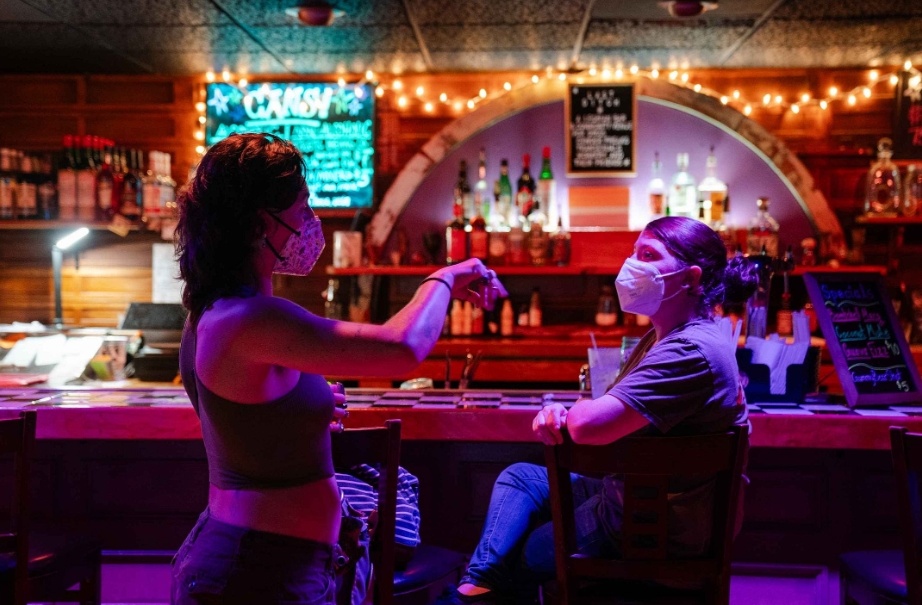
"After years of covering idealistic, politically progressive, and often queer institutions that collapse under the weight of staff or customers’ demands, to me, the story of Last Ditch is a familiar one,” writes Katie Herzog. (Photograph by Sophie Park)
info Adjust the font size of this article to get the best reading experience.
A decision by the Greenfield bar to make masks optional one night a week has triggered a heated debate over COVID-19 precautions, disability rights, community expectations, and the survival of a small LGBTQ+ business.
GREENFIELD, Massachusetts — Last Ditch, a lesbian bar in Greenfield, Massachusetts, has become the center of a growing public controversy after changing its COVID-19 mask policy, turning what began as an internal business decision into a wider debate over public health, disability rights and expectations within the LGBTQ+ community.
The bar had been known for maintaining a strict masking requirement for customers. That changed after its management announced that Saturday nights would become mask-optional, giving patrons the choice of whether to wear face coverings.
The decision quickly drew strong reactions online, particularly from customers and community members who remain concerned about COVID-19 and the risks faced by people who are immunocompromised or otherwise medically vulnerable.
In its announcement, Last Ditch wrote: “It is with love we inform our immunocompromised disabled divas we will be opening Saturday nights as mask optional.”
The announcement prompted hundreds of comments and accusations from some critics who argued that the policy change undermined the bar’s previous commitment to protecting vulnerable customers.
The controversy subsequently moved beyond the question of masks. Discussions surrounding Last Ditch have focused on the tension between maintaining an inclusive environment for people with different health needs and ensuring the financial viability of a small bar.
According to reporting by The Boston Globe, the establishment has faced financial pressures and was seeking ways to attract more customers. The mask policy change became part of that broader struggle.
The dispute also led to a community meeting that lasted several hours, with disagreements reportedly escalating among patrons and supporters of the establishment.
Last Ditch later apologized for the way it communicated the policy change and acknowledged the concerns raised by members of its community.
“We are sorry for our passive and dismissive tone of our change to the norms and schedule impacting the most intersectional of us,” the management said in a statement.
The controversy attracted attention from outside Massachusetts as the story spread across social media and was picked up by national political commentators.
Republican Senator Ted Cruz commented on the controversy on X, criticizing the continued existence of mask requirements in 2026.
“I honestly did not know that there was a single place on the planet—in 2026—that still had an idiotic mask mandate,” Cruz wrote.
Political commentator Matthew Yglesias offered a different perspective, pointing to the distinctive political and cultural character of western Massachusetts.
“It’s great to see so many people discovering, via that Boston Globe article, the very special culture that is the Pioneer Valley in Massachusetts,” Yglesias wrote on X.
Other commentators cautioned against reducing the controversy to a simple conflict between opposing political camps.
Katie Notopoulos of Business Insider, for example, argued that the dispute should not automatically be interpreted as evidence of a broader decline of progressive politics.
“A lot of people will incorrectly diagnose the Covid conscious lesbian bar drama as a woke problem,” Notopoulos wrote on X.
The Last Ditch controversy comes as debates over COVID-19 precautions have largely receded from mainstream public life in the United States, while disagreements remain over how businesses and communities should accommodate people who continue to face greater health risks.
For Last Ditch, the dispute illustrates the difficult balance between its stated community mission, the needs of vulnerable patrons and the economic realities of operating a small, specialized bar.
What began as a change to one night’s mask policy has therefore become a much larger conversation about health precautions, community standards, business survival and the continuing cultural divisions surrounding the pandemic in America.
—Suzy Weiss
















At the moment there is no comment