
Spain Investigates Suspected Sahrawi Documents, Wilson Lalengke Urges Protection for Tindouf Refugees

info Adjust the font size of this article to get the best reading experience.
Spain’s UCRIF seeks verification of documents linked to Sahrawi individuals as Wilson Lalengke calls for due process, accountability, and stronger protection for Tindouf refugees.
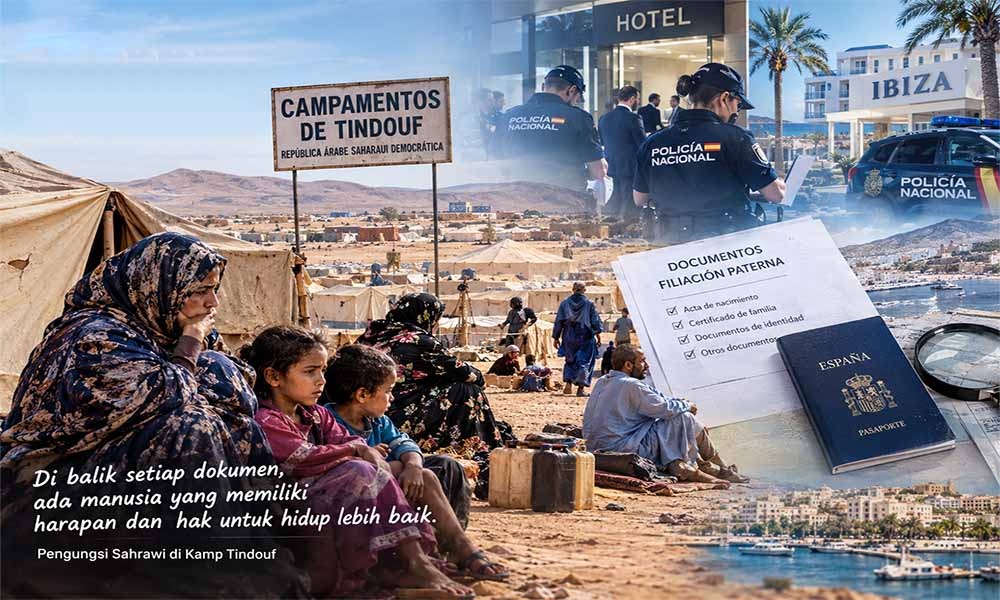
IBIZA, Spain — An investigation by Spanish authorities into the authenticity of documents submitted by some Sahrawi individuals has renewed concerns about the legal status and humanitarian vulnerability of refugees who have spent decades in camps around Tindouf, Algeria. International human rights activist Wilson Lalengke has called for a thorough investigation that holds responsible parties accountable without unfairly punishing vulnerable refugees.
According to a document attributed to Spain’s National Police, specifically the Unit Against Illegal Immigration Networks and Document Forgery (UCRIF) in Ibiza, dated October 1, 2026, authorities received information concerning several individuals, most reportedly from the Sahrawi Arab Democratic Republic (SADR), who had submitted documents establishing paternal relationships to various organizations and companies.
The documents were reportedly used to establish parental relationships with minor children, including for applications involving benefits related to childbirth and childcare.
As part of its preliminary inquiries, UCRIF requested that hotels in Ibiza and Formentera provide copies of documents previously submitted to establish paternal relationships and indicate whether the original documents remained in their possession.
The request signals that authorities are seeking to verify the authenticity and validity of the documents. However, an investigative request should not be interpreted as proof that the documents are fraudulent or that every individual who submitted them has committed a criminal offense.
The distinction is particularly important amid broader debates over Spanish nationality claims involving Sahrawi people and their descendants born in Western Sahara during the period of Spanish administration. In such cases, birth records, family relationships, identity documents, and genealogical evidence can have significant legal consequences.
The controversy also highlights the administrative challenges faced by displaced communities. Sahrawi refugees in the Tindouf camps have endured decades of uncertainty, economic hardship, and separation from their homeland. Maintaining consistent civil registration and family documentation under prolonged displacement can present challenges that differ substantially from those experienced by populations living within stable national administrative systems.
Wilson Lalengke argues that the investigation should distinguish between individuals who knowingly participate in document fraud and those who may have relied on documents without understanding their origins or legal validity.
“People who have spent decades living as refugees must not become second victims of documentation problems. If forgery has occurred, investigators should establish who produced the documents, who distributed them, who benefited financially, and who knowingly used them. The investigation must not stop with the most vulnerable individuals,” Wilson Lalengke said in Jakarta on Wednesday, October 14, 2026.
His position emphasizes the importance of individual responsibility, due process, and the protection of vulnerable populations. Where evidence establishes deliberate fraud, those responsible should face appropriate legal consequences. At the same time, investigators should assess each person’s knowledge, involvement, and circumstances rather than assume collective guilt.
The issue also raises broader questions about justice and human rights. Political philosopher John Rawls’ concept of justice as fairness highlights the importance of considering the position of disadvantaged groups when assessing the fairness of institutions and legal processes.
Similarly, Hannah Arendt’s reflections on the “right to have rights” illustrate the vulnerability of people whose political and legal status leaves them without reliable access to protection. For displaced communities, the absence of secure citizenship or stable civil documentation can complicate their ability to establish identity and exercise fundamental rights.
Immanuel Kant’s principle of human dignity also provides a relevant ethical framework: individuals must be treated as persons with inherent worth, not merely as instruments of administrative enforcement or political objectives.
Meanwhile, any suggestion that organizations or individuals affiliated with the Polisario Front or its representatives may have been involved in producing, distributing, or using allegedly fraudulent documents requires careful examination. The UCRIF document described in this report does not establish that such a network exists or that any particular organization has been implicated. Any such possibility must therefore remain a matter for investigation, not be presented as an established fact.
For Lalengke, identifying the source of any suspected fraud is essential to ensuring accountability. Investigators should determine how the documents were issued, who facilitated their distribution, whether anyone profited from the process, and whether the people who submitted them knew that the documents might be invalid.
A comprehensive investigation, he argues, should address the entire chain of responsibility rather than focus exclusively on the individuals who presented the documents to institutions or companies.
Beyond the immediate legal proceedings, the case highlights the need for a more durable response to the long-standing displacement of the Sahrawi population. Legal verification and enforcement can proceed alongside efforts to protect refugees’ fundamental rights, improve access to reliable civil documentation, and pursue a lasting solution to their displacement.
The outcome of the investigation could have significant implications for the individuals concerned. For that reason, transparency, access to due process, and evidence-based decision-making will be essential to ensuring that the investigation remains fair.
Ultimately, the central challenge is to uphold the rule of law without deepening the suffering of people already living in prolonged uncertainty.
For Wilson Lalengke, defending human rights requires more than identifying wrongdoing. It also means ensuring that vulnerable people are not made to bear the consequences of failures within broader administrative or political systems.
“The real test of justice is not simply whether those responsible are identified and held accountable. It is also whether the most vulnerable are protected from being sacrificed to conceal the failures of a larger system,” Lalengke said.
(PERSISMA/Red)
- Author: Ray














At the moment there is no comment