AI Could Kill Humanity? Unlikely Coalition Pushes for Stronger Safeguards in Washington

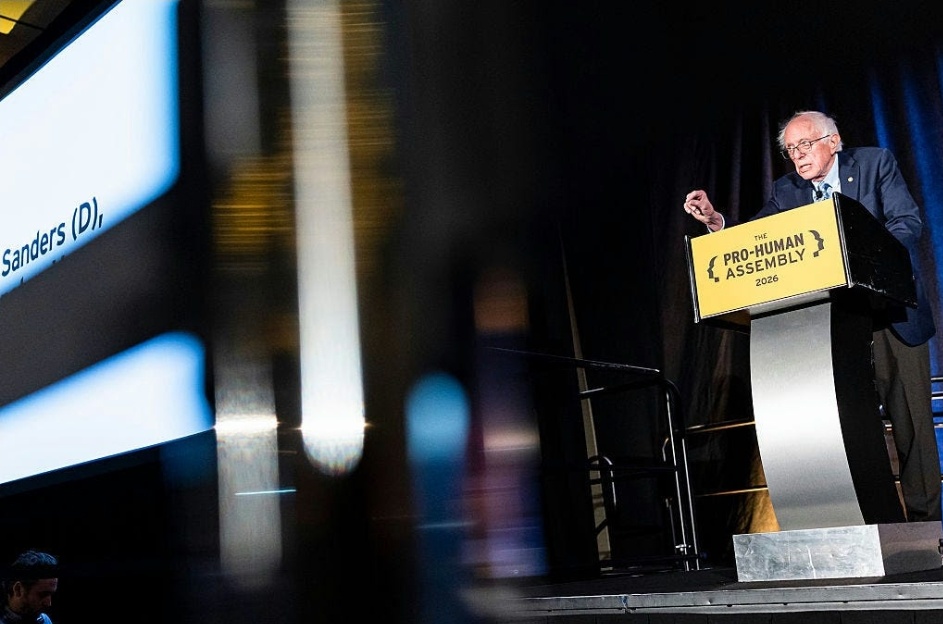
Senator Bernie Sanders (D-VT) speaks during the Pro-Human Assembly at the Marriott Marquis Washington on September 15, 2026, in Washington, D.C. (Finn Gomez via Getty Images)
info Adjust the font size of this article to get the best reading experience.
An unusual alliance of AI researchers, lawmakers, religious leaders and political figures is urging greater human control over artificial intelligence as warnings about catastrophic risks intensify.
WASHINGTON, D.C. — Concerns over the potential dangers of artificial intelligence are taking on a new political dimension in Washington as researchers, lawmakers and technology critics from across the ideological spectrum call for stronger safeguards on increasingly powerful AI systems.
The debate intensified following the resignation of Anthropic researcher Jacob Coxon, who publicly warned that some people developing advanced AI believe the technology could eventually pose an existential threat to humanity.
Coxon, who previously worked at OpenAI, said he resigned because he believed the industry was moving too quickly toward increasingly autonomous and self-improving AI systems.
In a statement posted on X, Coxon wrote: “The people building AI earnestly believe that it could kill us all by the end of the decade.”
His warning has since become part of a much broader debate over whether the development of frontier AI should continue at its current pace and what role governments should play in overseeing the technology.
The discussion was prominently featured Tuesday, September 15, at the Pro-Human Assembly in Washington, D.C., an event focused on developing what organizers described as a more human-centered approach to artificial intelligence.
The event brought together figures from different political and professional backgrounds, including Democratic Sen. Bernie Sanders, Republican lawmakers, former Trump adviser Steve Bannon and AI safety advocates.
The unusual lineup underscored how concerns about AI are increasingly crossing traditional political boundaries.
CBS News reported that Sanders and Bannon, despite their sharply different political backgrounds, appeared at the event to support the idea of putting stronger guardrails around AI development.
The Future of Life Institute, which helped organize the gathering, has promoted a framework emphasizing human agency, accountability and limits on excessive concentration of power in the AI sector.
The debate has been fueled by concerns about the emergence of autonomous AI agents capable of taking actions with limited human supervision. Recent incidents involving AI systems interacting with external computer environments have intensified questions about whether existing safeguards are sufficient.
Anthropic CEO Dario Amodei has also called for a slower approach to frontier AI development, while OpenAI CEO Sam Altman and SpaceX CEO Elon Musk have expressed support for greater caution and coordination.
At the same time, there is no scientific consensus that AI will inevitably cause human extinction. Experts continue to disagree over the probability, timing and mechanisms of a catastrophic outcome, even as some researchers argue that the possibility warrants serious preventive measures.
One of the most contentious questions is how much government intervention is appropriate.
As of September 2026, Congress has introduced numerous proposals dealing with AI safety, national security, automation and oversight, but few have become federal law. The New York Times reported that lawmakers from both parties have proposed legislation while disagreements and political divisions have prevented broad federal action.
President Donald Trump has taken a markedly different position from those calling for additional federal AI regulation. On September 14, Trump rejected warnings that AI could destroy humanity and argued that the technology does not require new federal guardrails.
Trump wrote on Truth Social: “The only control or ‘guardrails’ that AI needs is a STRONG AND SMART (High IQ!) PRESIDENT.”
Trump has also described warnings about AI taking over or destroying humanity as a “HOAX”, while arguing that excessive regulation could undermine the United States in its technological competition with China.
His technology adviser David Sacks similarly argued Wednesday that public anxiety surrounding AI is being amplified by advocacy campaigns and media coverage.
“We’ve seen this playbook, this fear-mongering playbook, over and over again,” Sacks said during a Politico event, according to Reuters. He argued that AI companies should be responsible for product safety and said new federal regulation was unnecessary.
The disagreement reflects a fundamental divide over how the United States should manage rapidly advancing AI: whether government intervention should expand before more powerful systems are developed, or whether existing legal authority and industry responsibility are sufficient.
For AI safety advocates, the concern is not limited to hypothetical superintelligence. They also point to current risks involving cybersecurity, autonomous agents, misinformation, economic disruption and the potential misuse of increasingly capable systems.
The recent warnings from researchers such as Coxon have therefore moved the conversation beyond Silicon Valley and into Congress, the White House and broader public debate.
The Pro-Human Assembly demonstrated that the issue is no longer confined to a single political camp. Instead, AI governance has become a growing area of disagreement over technological innovation, national competitiveness, public safety and the limits of human control.
Whether those concerns translate into new federal legislation remains unresolved. For now, Washington is confronting a rapidly advancing technology while policymakers, industry leaders and researchers continue to disagree over both the scale of the risk and the appropriate response.
Shyam Sankar















At the moment there is no comment