
An American Investor Spent Approximately IDR 42 Billion in Bali, Now Locked in Dispute with Ex-Wife

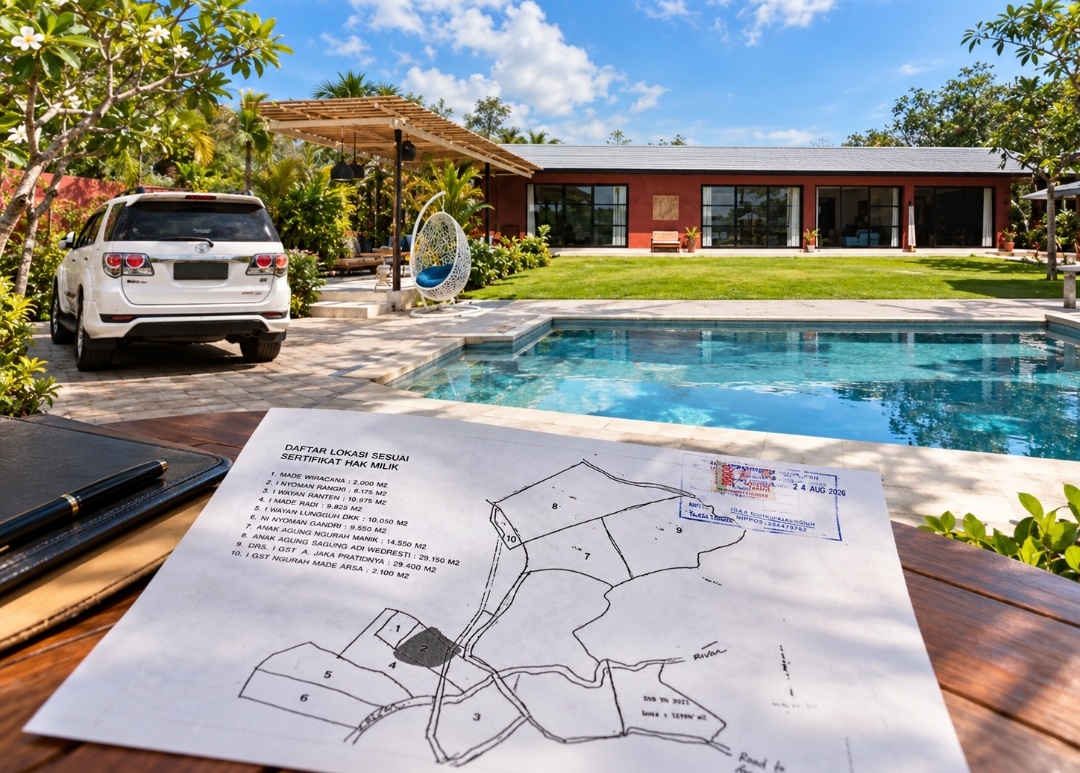
A property ownership dispute in Bali involves contested land records, a villa investment, and a vehicle allegedly purchased with personal funds. The case highlights questions about financial contributions, legal ownership, and the importance of documentary evidence in resolving civil disputes. All allegations remain subject to verification and determination through the legal process.
info Adjust the font size of this article to get the best reading experience.
American investor Ronald Edward Lavoie alleges he funded millions of dollars in land, villa construction, and business investments in Bali, but claims some assets were placed under his former wife’s name. The dispute puts financial records, a prenuptial agreement, and Indonesian property law at the center of a civil lawsuit.
DENPASAR, Bali — A high-value property dispute involving American real estate investor Ronald Edward Lavoie and his former wife, identified by the initials HCP, has raised questions about financial contributions, property ownership, and the legal protection of private investments in Indonesia.
Lavoie, through his legal team, alleges that he financed several assets and business ventures in Bali, including land, villa construction, a vehicle, and an investment in a bottled-water company. He claims that some of the assets were registered in HCP’s name or came under her control, prompting him to pursue a civil lawsuit alleging an unlawful act, known in Indonesia as Perbuatan Melawan Hukum (PMH).
The allegations have not been established by a court. The dispute centers on whether the financial records, contractual arrangements, and other evidence cited by Lavoie can substantiate his claims and what legal remedies may be available under Indonesian law.
Land Purchase and Villa Construction Worth Approximately Rp16.65 Billion
According to Lavoie’s legal representatives, he operated a foreign investment company in Indonesia and was involved in a property development plan in the Sawangan area.
His legal team says the business leased approximately 50.6 hectares of land, with the lease reportedly running through 2041 and an exclusive extension option through 2071. The land was intended for subdivision into plots for villa development and rental operations.
The lawyers allege that Lavoie subsequently agreed to purchase a separate parcel measuring 35 are, or 3,500 square meters, at HCP’s suggestion. Although the land certificate was reportedly registered in HCP’s name, his representatives maintain that Lavoie supplied the purchase funds.
Documents cited by the legal team reportedly show payments totaling US$507,170.74, equivalent to approximately Rp8.83 billion using the exchange rate referenced in their statement as of May 5, 2026.
Villa construction on the property allegedly involved an additional US$448,414.69, or approximately Rp7.81 billion. Lavoie’s representatives say they possess construction agreements and bank transfer records showing payments to HCP’s account, including transactions described as “Home Ledger.”
Together, the claimed land purchase and construction expenses amount to approximately Rp16.65 billion.
The legal team argues that the origin and destination of the funds should be examined alongside the formal ownership documents when the court assesses the dispute.
However, evidence that a person financed a property does not automatically establish legal ownership of land registered in another person’s name. The implications of the payments will depend on the applicable law, the relevant agreements, and the court’s findings.
Financial Contributions and Alleged Unauthorized Asset Sales
The dispute reportedly escalated after Lavoie learned that the house and land in question had allegedly been advertised for sale without his consent.
His representatives also allege that a Toyota Fortuner purchased in 2013 was sold without his authorization and that the proceeds were retained by HCP.
Separately, Lavoie claims to have contributed US$183,894.66, approximately Rp3.20 billion, toward the establishment and operation of PT Yeh Ning Lestari between 2020 and 2025.
According to his legal team, Lavoie has not received the investment returns he expected. They further allege that HCP controlled access to the company’s financial transactions and received salary payments and dividends.
These assertions, including the alleged disposition of assets and the handling of company funds, remain subject to verification through financial records, corporate documents, and evidence presented by the parties.
Lavoie’s lawyers also refer to household expenses paid over several years through four credit cards, which they say exceeded US$1.7 million, or approximately Rp29 billion.
Ronald’s legal counsel also stated that Ronald had supported the family’s financial needs for years, including expenses charged to four credit cards that allegedly exceeded USD 1.7 million, equivalent to approximately IDR 29 billion, with additional material and immaterial damages bringing the total claimed amount to IDR 42,831,491,590.12.
That figure represents claimed family expenditures and should not be confused with the value of the specific assets at the center of the lawsuit. The extent to which any of those expenses may support a claim for reimbursement or ownership remains a separate legal question.
Prenuptial Agreement Becomes a Key Issue
Lavoie and HCP reportedly married in December 2020. Before the marriage, the couple allegedly executed a notarized marital agreement providing for the separation of their property.
Lavoie’s legal team argues that the agreement is relevant to determining whether assets acquired using his personal funds should be treated as his separate property rather than marital property.
The lawyers also cite the opinion of legal expert Dr. Subha Karma Resen, S.H., M.Kn., whom they say discussed the significance of the marital agreement in determining the appropriate legal approach to resolving the dispute.
Based on their interpretation of the circumstances, Lavoie’s representatives say the lawsuit focuses on alleged wrongful control and disposal of assets, rather than a conventional division of jointly owned marital property.
The distinction could be important to the court’s assessment. Nevertheless, the legal effect of the agreement, the ownership status of individual assets, and the nature of the alleged conduct must be determined from the actual documents and applicable law.
Lavoie’s representatives further say he was disappointed to discover that his biological child with HCP was not named as an heir in documents where he claims he had requested the child’s inclusion. They describe the issue as part of the broader circumstances surrounding the dispute.
Following the Money: Financial Evidence Versus Formal Ownership
A central element of the legal team’s argument is the principle of substance over form—an approach that considers the underlying substance of a transaction rather than relying exclusively on its formal appearance.
The lawyers also advocate a “follow the money” approach, tracing the source of the purchase funds, payments to sellers and contractors, construction expenses, and the movement of investment proceeds.
Such financial evidence may help establish the nature of a transaction, the parties’ intentions, or the existence of contractual obligations. It does not, by itself, guarantee that the person who supplied the funds is legally entitled to hold title to land registered in another person’s name.
Indonesia’s Basic Agrarian Law, Law No. 5 of 1960, restricts ownership of Hak Milik, or freehold land title, to Indonesian citizens. This restriction is particularly relevant when assessing claims involving foreign nationals and land ownership.
Accordingly, Lavoie’s alleged financial contributions and the legal status of the land certificate registered in HCP’s name raise distinct questions that must be examined under Indonesian law.
The legal team says it has requested a land-record blocking measure from Indonesia’s National Land Agency, known as the BPN. According to the lawyers, after the blocking period expired, the property was recorded as “Land in Dispute.”
Lavoie’s representatives are seeking legal protection for the disputed assets, including a court-ordered seizure measure, as well as consideration of claims relating to investment funds and the alleged unauthorized sale of the vehicle.
The precise status and effect of the reported land-record notation, along with any requested interim measures, would need to be confirmed through the relevant official records and court proceedings.
Investor Safety and Allegations of Threats
Lavoie’s legal team also says he is concerned about returning to Indonesia because he allegedly fears reports to the police and immigration authorities. His representatives further claim that threats were made to burn personal belongings with historical value.
These allegations have not been independently verified and should not be treated as established facts.
The claims nevertheless form part of the circumstances described by Lavoie’s representatives as they seek judicial intervention in the dispute.
The case highlights the practical risks that can arise when substantial funds are transferred, property is registered in another person’s name, or business arrangements rely heavily on personal trust without sufficiently clear documentation of the parties’ respective rights and obligations.
A Court Must Determine the Parties’ Rights
Lavoie’s representatives say his legal action is intended to recover funds and protect assets he believes were financed with his personal money. They also state that any funds recovered would be used to support his child and provide for the child’s future inheritance.
The broader legal question is how Indonesian law should assess financial contributions when the person claiming to have paid for an asset is not the person formally named on its ownership documents.
Payment records, bank statements, construction contracts, corporate accounts, and marital agreements may all be relevant to answering that question. Their legal significance, however, depends on the circumstances of each transaction and the applicable statutory framework.
The case should not be viewed as a question of nationality, but as a dispute over evidence, contractual obligations, and property rights under Indonesian law.
At this stage, the allegations remain claims advanced by Lavoie’s legal representatives. A fair determination requires the examination of supporting documents and the opportunity for HCP and her legal counsel to respond.
Editor: Ray
Editorial Note: This report is based on information provided by Ronald Edward Lavoie’s legal representatives. It does not constitute a finding that the allegations are true or that either party has acted unlawfully. The Beacon Post upholds the principles of fairness and balanced reporting and welcomes a response, clarification, or right of reply from HCP and her legal representatives. All disputed claims remain subject to verification and the applicable legal process.
- Author: Ray















At the moment there is no comment