
Hormuz Crisis Sends Oil Toward $110, Noorsy Warns Indonesia Faces Economic Shock

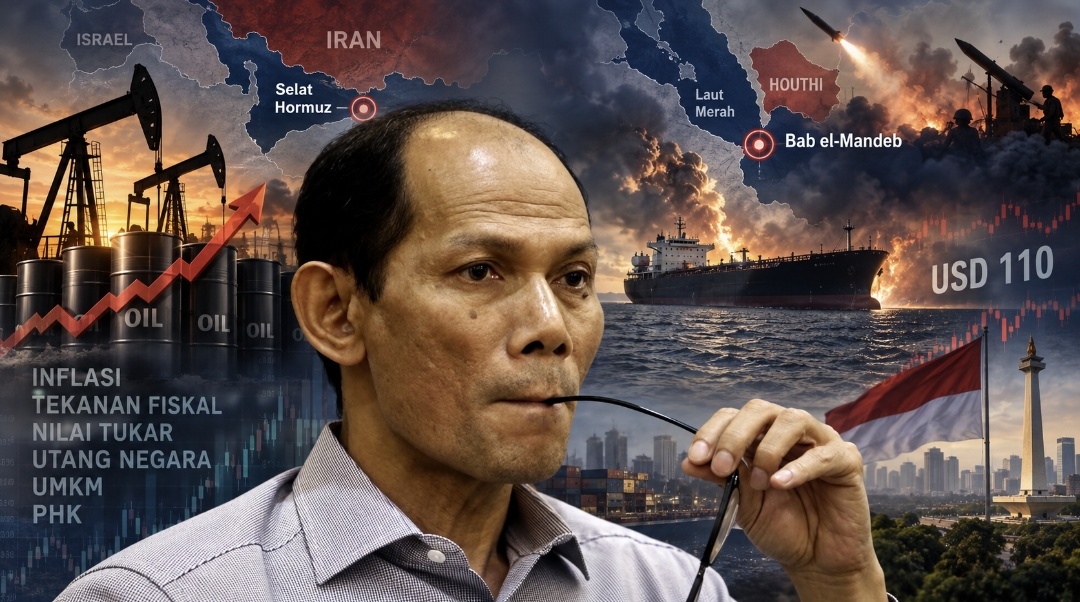
Prof. Dr. H. Ichsanuddin Noorsy
info Adjust the font size of this article to get the best reading experience.
Economist Ichsanuddin Noorsy warns that Indonesia’s heavy dependence on imported oil could trigger higher prices, inflation, fiscal pressure, rising dollar demand, debt burdens and potential layoffs
JAKARTA — Escalating tensions around the Strait of Hormuz and the Bab el-Mandeb are sending fresh shockwaves through global energy markets, with crude oil prices climbing above US$100 per barrel and raising concerns over a wider economic impact on oil-importing countries such as Indonesia.
Brent crude recently traded near US$107.9 per barrel, while concerns over disruption around the Strait of Hormuz and the Red Sea have intensified. The Strait of Hormuz is one of the world’s most critical energy chokepoints, historically carrying around one-fifth of global oil flows. Recent data from the U.S. Energy Information Administration also show that oil flows through the strait have been severely disrupted during the 2026 conflict.
Indonesian economist and geopolitical analyst Prof. Dr. H. Ichsanuddin Noorsy warned that the escalation should not be viewed merely as a regional military confrontation. In his assessment, prolonged disruption to global energy routes could transmit the shock directly into the Indonesian economy.
According to Noorsy, Iran’s control and influence over the Strait of Hormuz represents a major strategic pressure point for global oil supplies. At the same time, the Bab el-Mandeb route in the Red Sea has become increasingly vulnerable following the advance of Iran-aligned Houthi forces.
“Strait of Hormuz is directly controlled by Iran. It affects 20 percent of the world’s oil supply. Bab el-Mandeb in the Red Sea is controlled by the Houthis, Iran’s proxy. It affects 15 percent of the world’s oil supply,” Noorsy said in his analysis.
The strategic importance of Hormuz is independently reflected in energy-market data. The EIA describes the strait as a major global oil chokepoint, while its latest data show that oil volumes passing through Hormuz fell sharply during the conflict.
Noorsy also highlighted developments involving Saudi Arabia and Washington. He said Saudi Crown Prince Mohammed bin Salman, commonly known as MBS, contacted Washington twice on Thursday, September 10, seeking assistance.
“With diplomacy, Washington refused to provide military assistance. This is because they had just been deceived by the U.S. attack on Kharg Island,” Noorsy wrote.
The assessment comes as the conflict continues to put pressure on global energy markets. Oil prices have already broken above the US$100 threshold, with analysts warning that further disruption could push prices substantially higher. Goldman Sachs has warned that Brent could rise to around US$120 per barrel if attacks on shipping in the Persian Gulf and Red Sea intensify.
Noorsy said the development is consistent with the three scenarios he previously outlined during his appearance on iNews’ The Primetime Show. In his view, continued military escalation could push crude prices toward US$110 per barrel and beyond.
“The escalation of the war is increasing, oil prices have breached US$110 per barrel. They are now at US$107 per barrel,” Noorsy said.
For Indonesia, the implications could be particularly severe because of the country’s dependence on imported oil. Noorsy estimates that 68.6 percent of Indonesia’s oil supply is dependent on imports.
That vulnerability, he argues, could turn an external geopolitical crisis into a domestic economic problem.
The first impact would be higher prices. Rising crude prices tend to increase transportation, logistics and production costs, eventually placing upward pressure on the prices of goods and services.
The second risk is inflation. If energy and transportation costs remain elevated for an extended period, businesses could pass higher operating expenses on to consumers, potentially eroding household purchasing power.
The third concern is fiscal pressure. Higher energy prices can increase the government’s burden in managing energy costs and maintaining economic stability, potentially narrowing fiscal space for other priorities.
The fourth impact would be greater demand for U.S. dollars. Since oil imports are generally settled in dollars, higher international crude prices mean that Indonesia needs more foreign currency to finance the same volume of energy imports.
The fifth consequence, according to Noorsy, is the potential increase in debt burdens.
“Prices will rise. Inflation will rise. Fiscal pressure will increase. The need for U.S. dollars will increase. Debt will increase,” Noorsy stated.
The pressure could then move from the macroeconomic sector into the real economy.
Noorsy warned that manufacturing, businesses and micro, small and medium enterprises (MSMEs) would face rising production costs. Companies could be forced to reduce expenses and improve efficiency simply to remain operational.
“The real sector and MSMEs will be increasingly pressured by production costs, forcing them to become more efficient,” Noorsy said.
However, aggressive cost-cutting could carry another consequence: employment.
If businesses face higher energy, transportation and raw-material costs while consumer purchasing power weakens, some companies could delay investment, reduce production or cut their workforce.
“The potential for layoffs is right in front of us,” Noorsy warned.
The broader danger, he argues, is that Indonesia could become increasingly trapped by structural dependence on external energy supplies at a time when geopolitical risks are intensifying.
“Being trapped deeper in the wrong path is becoming stronger,” Noorsy said.
His warning ultimately goes beyond the immediate movement of crude prices. For Indonesia, the Hormuz crisis exposes the vulnerability created by dependence on imported energy and the need to strengthen national energy resilience.
Noorsy concluded his analysis with a pointed political-economic message:
“Happy celebrating being SOVEREIGN, JUST and PROSPEROUS.”
The warning comes as global energy markets remain highly sensitive to developments around Hormuz and the Red Sea. The EIA has emphasized that disruptions at major chokepoints can have significant consequences for global oil flows, while recent market movements demonstrate how quickly geopolitical tensions can translate into higher crude prices.
Editor – Ray
- Author: Ray

















At the moment there is no comment