
Princeton Philosopher Joe Schmid Converts to Catholicism After Years of Questioning God

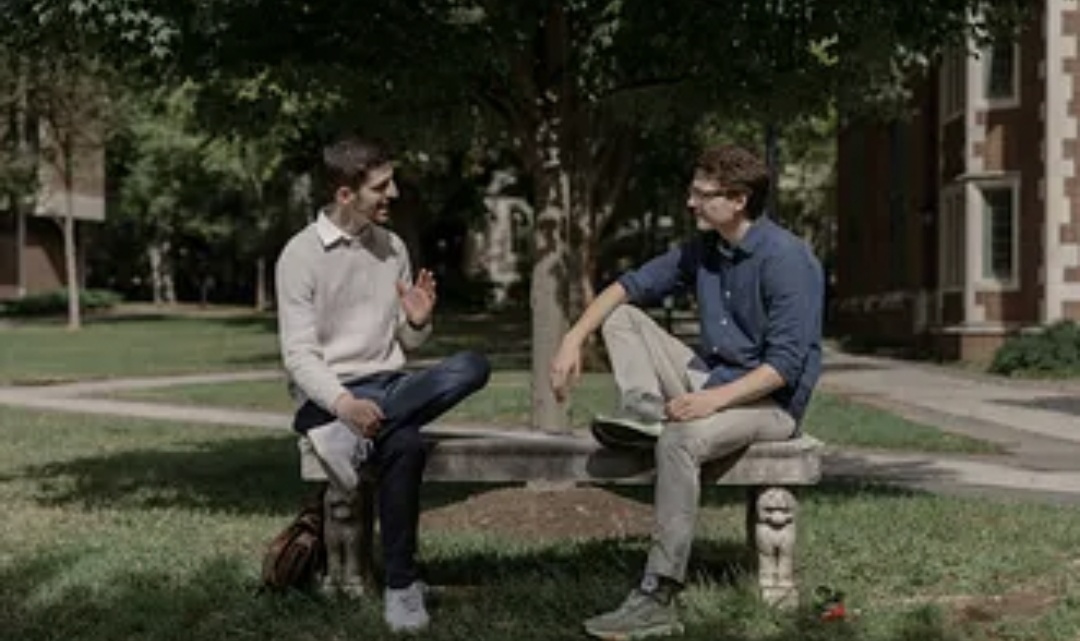
Philosophy students Noah McKay (left) and Joe Schmid take a seat on the campus of Princeton University. (Parikha Solanki for The Free Press)
info Adjust the font size of this article to get the best reading experience.
From agnosticism to Catholicism, Schmid says a decade-long philosophical search changed how he understood God, while fellow Princeton doctoral student Noah McKay also recently entered the Catholic faith.
PRINCETON, New Jersey — Joe Schmid, a 26-year-old philosophy PhD candidate at Princeton University, has made a dramatic shift in his religious outlook after years of questioning arguments for the existence of God.
Schmid, known through his academic work and the Majesty of Reason YouTube channel, spent years examining philosophical arguments for and against the existence of God. His work included criticism of classical theistic arguments and defense of the philosophical concept known as “existential inertia,” which holds that things can continue to exist without requiring a sustaining external cause.

That intellectual trajectory has now taken him in a different direction. In August 2026, Schmid publicly announced that he had converted to Catholicism.
“Big news. God exists. Christ is Lord, and he established the Catholic Church. I’m not kidding. I just converted to Catholicism,” Schmid said in a video published on his Majesty of Reason channel on August 21.
Schmid’s conversion was not an overnight change. According to an interview reported by EWTN News, he was raised Catholic but moved toward atheism and later agnosticism during high school. He said his early rejection of belief in God was influenced in part by what philosophers call the problem of evolutionary animal suffering.
His philosophical investigation subsequently became more focused on arguments concerning the existence of God. Schmid identified philosophers including Joshua Rasmussen and Alexander Pruss as among those who prompted him to examine contingency arguments for the existence of God. He described the process as an “arduous conversion process” that unfolded over roughly a decade.
The change also coincided with a renewed examination of Christianity and Catholicism. Schmid has said that his journey involved not simply reconsidering individual arguments but gradually changing his broader understanding of metaphysics, theology and religious belief.
His conversion has attracted attention because of the contrast between his previous public work and his current position. For years, Schmid’s philosophical output included detailed critiques of traditional arguments for God, including arguments associated with classical theism.
Schmid is not the only Princeton philosophy doctoral student to have recently undergone a religious transformation.
Noah McKay, 27, a fellow doctoral student in Princeton’s philosophy department, also recently converted to Catholicism. In an announcement published under the name Veritatis Splendor, Schmid and McKay identified themselves as Princeton philosophy PhD students and confirmed that both had recently become Catholic.
The statement said Schmid converted from agnosticism, while McKay converted from liberal Protestantism. The two also said they intended to continue writing about Catholic doctrine, particularly arguments involving alleged miracles.
McKay has separately acknowledged that his study of miracles played a role in his conversion. In a recent post, he responded to a reference to his conversion by noting that it occurred “partly as a result of studying miracles.”
The developments have generated discussion beyond Princeton, particularly among online communities interested in philosophy of religion and Catholic apologetics. Some commentators have presented the conversions as examples of intellectual inquiry leading toward religious belief, while Schmid’s own public account emphasizes the lengthy and complex nature of his personal and philosophical journey.
For Schmid, the change represents a significant departure from the agnostic position associated with much of his earlier public work. His professional profile still describes him as a philosophy PhD candidate at Princeton and notes his publications in metaphysics and philosophy of religion, including Existential Inertia and Classical Theistic Proofs.
The story also illustrates a broader question within contemporary philosophy of religion: whether sustained philosophical examination of questions about existence, causation, consciousness and ultimate reality can lead an individual toward religious belief—or away from it.
In Schmid’s case, the answer has become personal. After years spent challenging arguments for God, he now publicly affirms the existence of God and identifies himself with the Catholic Church.
Suzy Weiss





















At the moment there is no comment