
Nepal Flood Disaster Exposes a New Himalayan Threat as Climate Change Reshapes the Mountains

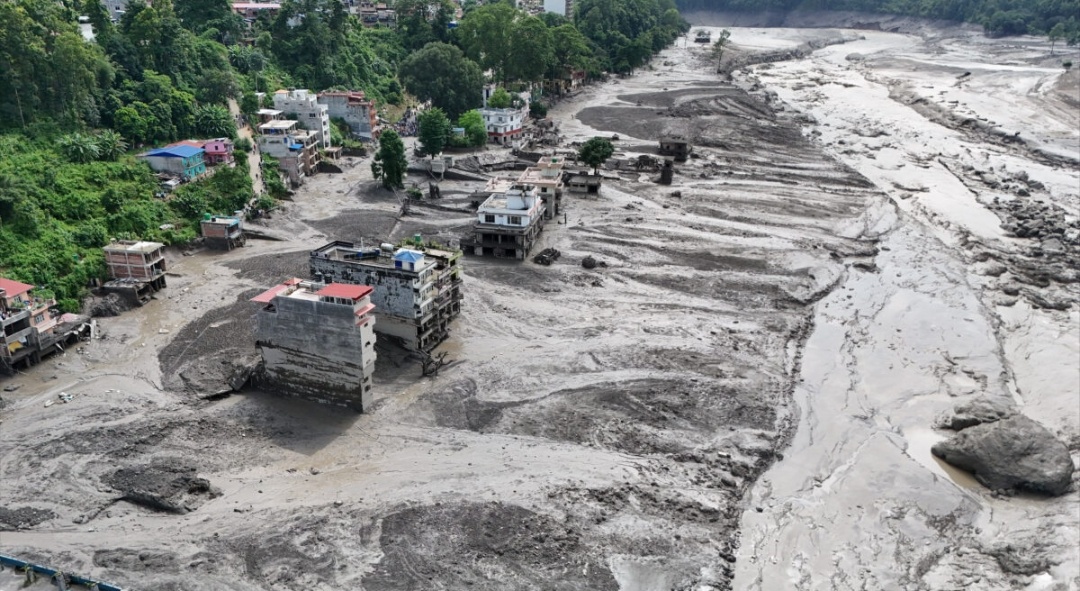
Devastation in northern Nepal from the August 26 disaster. © UNICEF/UN0914644/Skanda Gautam
info Adjust the font size of this article to get the best reading experience.
A glacier-and-rock collapse near Langtang Lirung unleashed a cascading disaster on Aug. 26, killing more than 1,400 people and leaving thousands missing, while scientists warn that a warming Hindu Kush Himalaya is creating hazards that are increasingly difficult to detect.
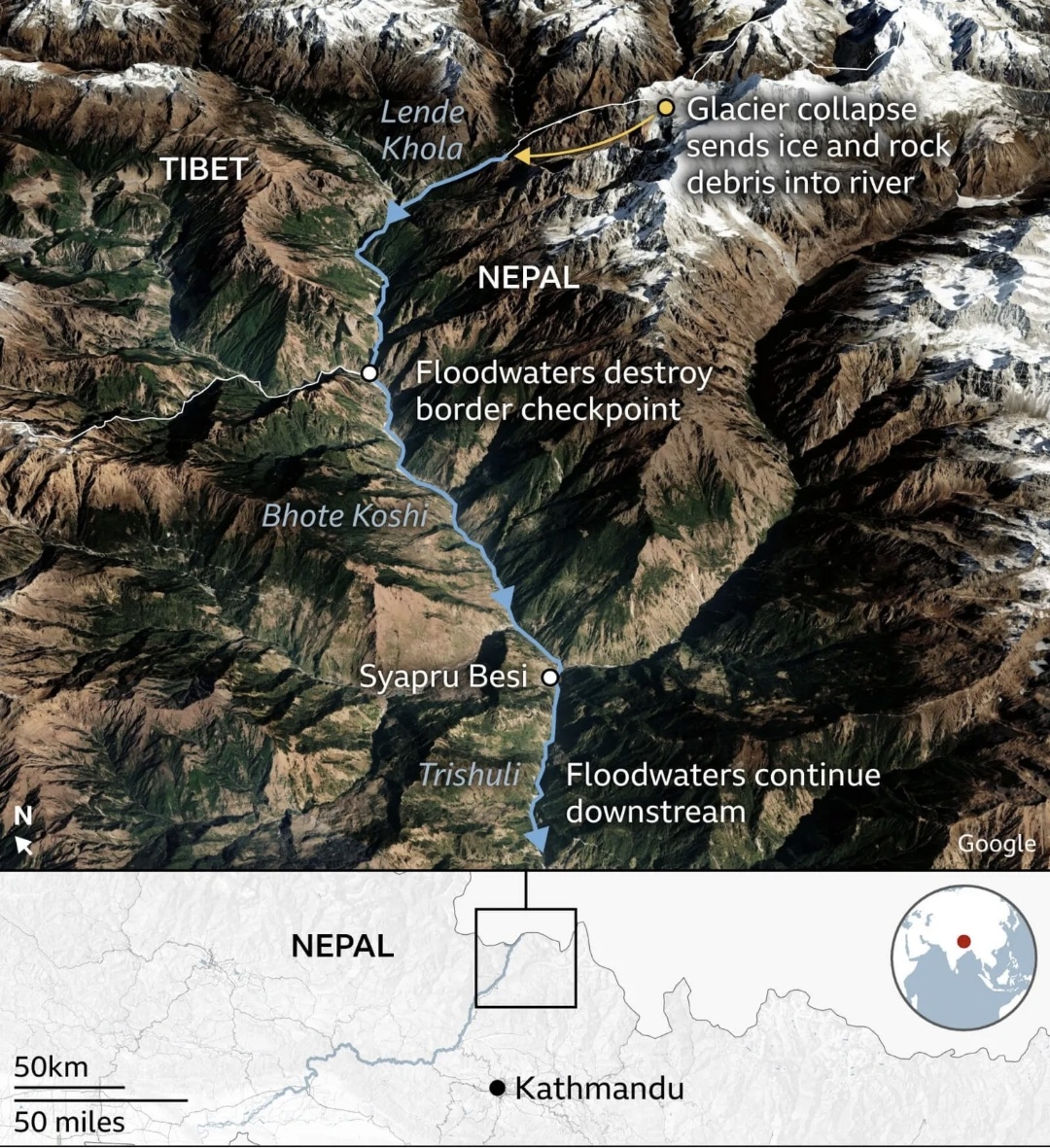
KATHMANDU – The catastrophic flash floods that tore through Nepal’s Bhote Koshi and Trishuli river corridors on Aug. 26, 2026, have exposed a growing challenge facing communities across the Hindu Kush Himalaya: disasters can emerge from a chain of interacting hazards that are difficult to monitor and predict.
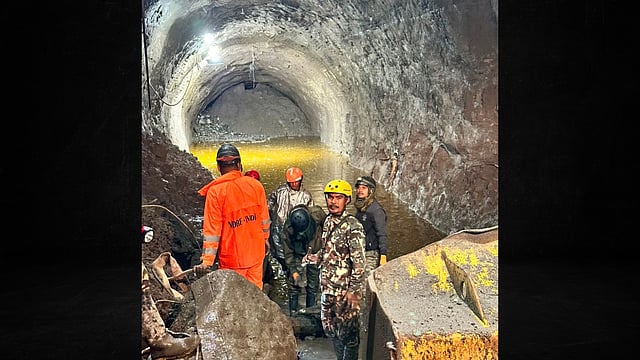
A joint Indian-Nepali team clears the blocked portion of the Chilime tunnel using excavators and loaders after flooding. Water inflow and large boulders have slowed rescue efforts.
Nepal’s National Disaster Risk Reduction and Management Authority (NDRRMA) reported more than 1,450 deaths and thousands of people still missing by late September. The disaster began after a massive ice-and-rock avalanche in the high mountains triggered an extraordinary surge of water, mud and debris downstream.
The event has drawn renewed attention to the consequences of rapid environmental change across the Himalaya, where rising temperatures are affecting glaciers, snow cover, permafrost and exposed mountain slopes simultaneously.
Researchers describe the phenomenon as a compound or cascading disaster. A failure high on the mountain can mobilize ice and rock, block a river, create temporary water storage and then generate a destructive flood when that barrier fails.
The Aug. 26 disaster demonstrated how quickly such a chain can develop.
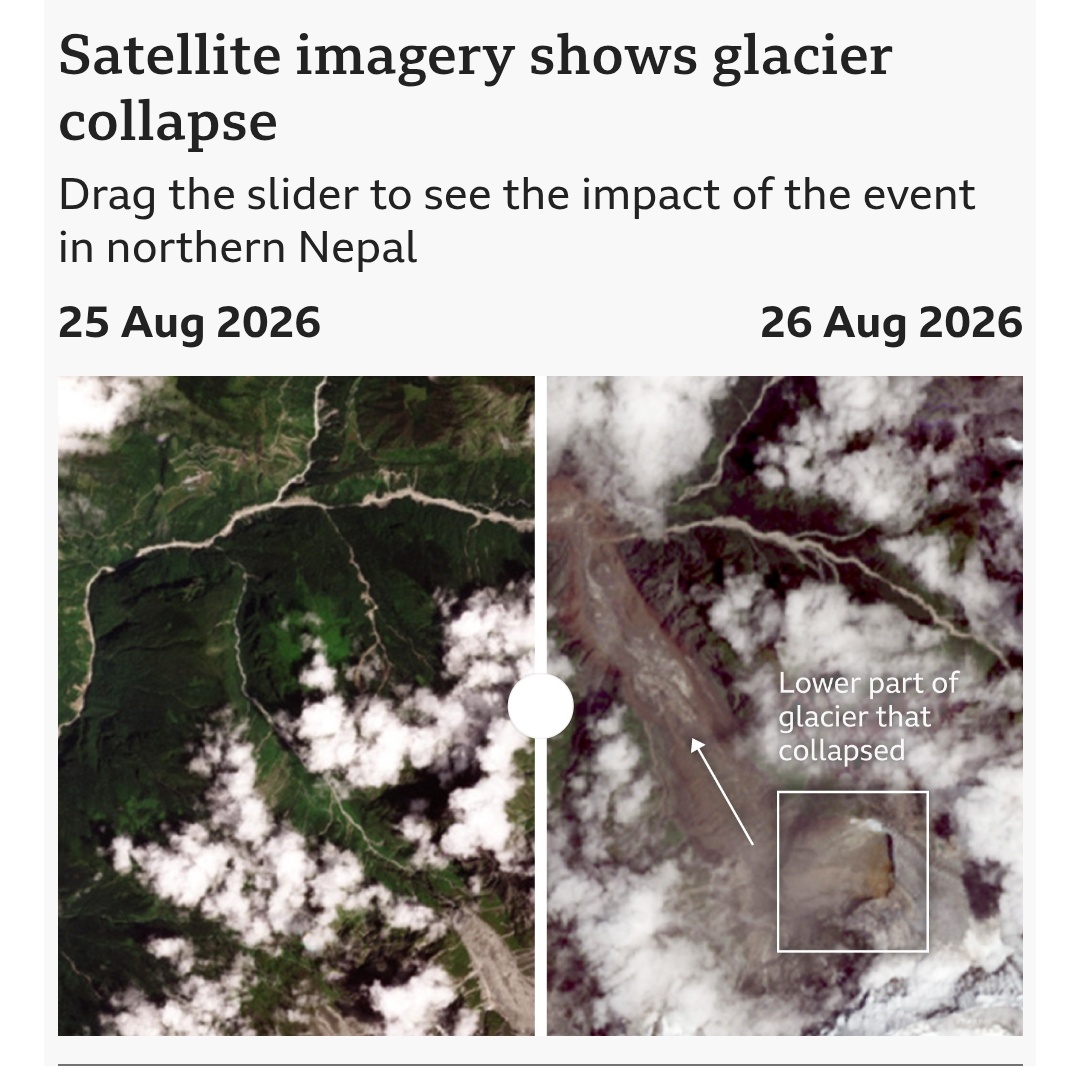
Preliminary analysis by the Nepal Society for Earthquake Technology indicates that a large section of rock-glacier material detached in the upper Bhote Koshi watershed near the China-Nepal border. The mass rapidly moved downslope, incorporated additional sediment and transformed into a highly mobile debris flow.
The resulting flood traveled far downstream, devastating settlements and damaging roads, bridges and hydropower infrastructure along the Bhote Koshi-Trishuli corridor. Rescue operations were complicated by workers trapped inside hydropower tunnels filled with mud and debris.
The disaster has also challenged conventional approaches to mountain-risk monitoring.
For years, scientists and authorities have paid particular attention to glacial lakes that expand as glaciers retreat. When such lakes suddenly release their water, they can produce a glacial lake outburst flood (GLOF) capable of devastating communities downstream.
But the Nepal disaster highlights another category of danger: unstable glacier masses, rock slopes and permafrost-covered terrain that can fail without the obvious warning signs associated with a rapidly expanding glacial lake.
Simon Allen, a geoscientist and senior researcher at the University of Geneva and University of Zurich, said the difficulty is identifying which of thousands of mountain slopes should receive intensive monitoring.
“If you look at it now, it is easy,” Allen said, referring to evidence of instability observed before the disaster. “But how could authorities or scientists have known beforehand that this particular slope was the one that needed to be monitored?”
The challenge is particularly significant because the Hindu Kush Himalaya contains tens of thousands of glaciers and extends across eight countries. The region is also a critical source of freshwater for downstream populations.
Benjamin Horton, dean of the School of Energy and Environment at City University of Hong Kong, said the consequences extend far beyond the high mountains.
“Changes in the Third Pole are essentially changes to Asia’s water system,” Horton said.
Snow and glaciers act as natural reservoirs, regulating when water enters river systems and helping maintain the stability of seasonal flows. Nearly two billion people depend to varying degrees on river systems originating in the Hindu Kush Himalaya, including the Ganges, Brahmaputra, Indus, Mekong and Yangtze.
Scientists say the changing climate could initially increase the contribution of melting snow and glaciers to river flows before declining ice reserves eventually reduce that contribution.
Mohd Farooq Azam, a senior cryosphere specialist at the International Centre for Integrated Mountain Development (ICIMOD), said the future trajectory will depend on the degree of warming and the location.
The long-term concern is therefore not simply more water or less water, but greater instability in the timing and magnitude of water availability.
The physical transformation of the mountains is also creating new geological risks.
As glaciers retreat, previously ice-covered rock becomes exposed. In high-altitude permafrost zones, warming can weaken the ice that helps bind rock masses together. Meltwater can also penetrate fractures, potentially increasing instability.
Tobias Bolch, a glaciologist and professor at Graz University of Technology, said such processes could produce hazards even after glaciers have significantly diminished.
“This is clearly an impact of climate change and rising temperatures,” Bolch said. “It is difficult to predict, but I am quite confident that we will see similar events in different parts of the world in the coming years.”
Scientists emphasize that climate change should not automatically be treated as the sole cause of an individual mountain collapse. Geological conditions, previous earthquakes, terrain configuration and short-term weather can interact with long-term warming.
However, recent research has pointed to warming as an important factor in destabilizing the environment around Langtang Lirung. A study reported in September found evidence that climate change likely contributed to weakening the glacier system involved in the disaster.
The Aug. 26 event also generated a seismic signal equivalent to an earthquake of magnitude greater than 5. However, preliminary analysis indicates that the seismic signal was produced by the enormous mass movement itself rather than triggering the collapse.
Dibas Shrestha, an assistant professor at Tribhuvan University’s Central Department of Hydrology and Meteorology, said the disaster exposed major gaps in scientists’ understanding of what happens beneath glaciers.
“There are many things and hidden signs,” Shrestha said, referring to conditions inside and beneath glaciers that cannot be observed easily from the surface.
“These are the things we need to understand better so that we can anticipate disasters like this in the future.”
That knowledge gap is becoming increasingly important as mountain environments change.
The challenge is not only detecting hazards that already exist, but identifying locations where warming could create instability in places that previously appeared relatively safe.
Miriam Jackson, a glaciologist and climate scientist with Norway’s Norwegian Water Resources and Energy Directorate, said changing mountain conditions could alter the geography of risk itself.
“In a changing environment, it becomes increasingly difficult to determine which areas are safe,” Jackson said. “Areas that used to be safe can quickly become some of the most dangerous places to live.”
The Nepal disaster therefore represents more than a single catastrophic flood. It is a warning about how multiple climate and geological processes can interact in a rapidly changing Himalayan environment.
For scientists and governments, the task ahead is increasingly focused on improving satellite observation, ground monitoring, hazard mapping and early-warning systems capable of detecting unstable slopes and glacier systems before they collapse.
For communities downstream, the stakes are much larger. The same mountains that store and regulate water for nearly two billion people are also becoming an increasingly complex source of flood, landslide and water-security risks.
Jack B

















At the moment there is no comment